
 Democratic Republic of Congo
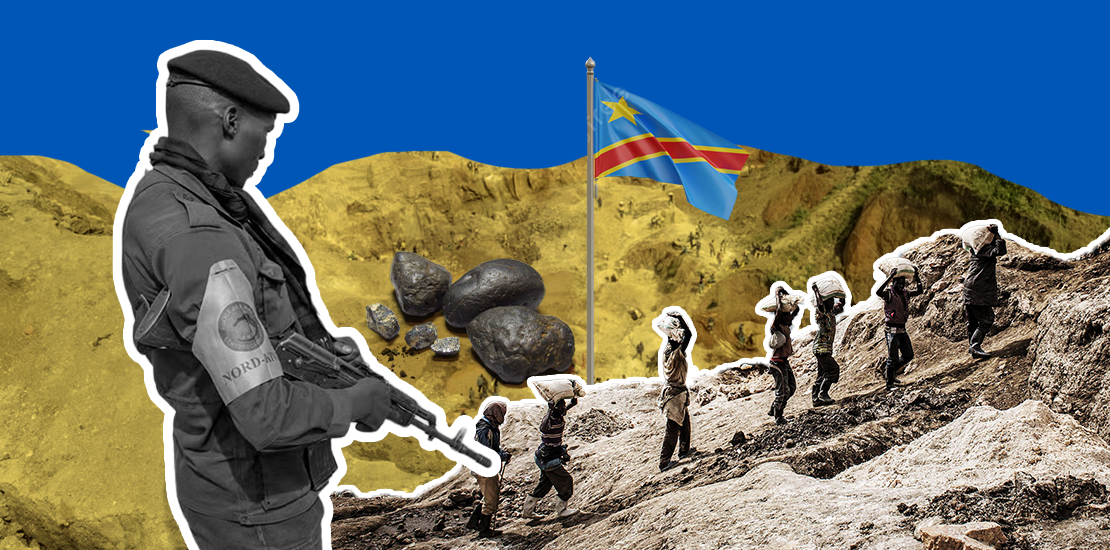
In the eastern Democratic Republic of the Congo (DRC), coltan not only feeds the world's electronics production chains: it also supports a highly structured underground economy. A strategic mineral for capacitors in telephones, computers, and military equipment, it places the DRC at the heart of rivalries over critical raw materials. But between the artisanal wells and the Asian or European smelters, a significant proportion of the volumes flow through parallel circuits, where local interests, regional stakes, and the constraints of international markets come together.
At the outset, the hills of North and South Kivu and Maniema are dotted with often isolated artisanal mining sites, where tens of thousands of miners work by hand. Field surveys show that many of these sites are subject to "interference" by armed actors or security forces: informal rights of way, bag tax, obligation to sell to an imposed intermediary. Even before any official registration, the value of the ore is already captured by a multitude of local rents.
From the pits, coltan follows a relatively stable logistics chain. Miners sell their production to capital-rich traders, who consolidate it in village and then urban depots, notably in Goma and Bukavu. In theory, the bags are weighed, registered, and labeled as part of traceability mechanisms set up with the support of the international community. In practice, however, reports from NGOs and UN agencies describe volumes deliberately removed from the registers, labels reused or misappropriated, and gaps in the accounting of actual tonnages.
It is at the border that parallel circuits become most visible. Investigations detail flows that take secondary routes, bypass official posts or cross Lake Kivu and Lake Tanganyika to Rwanda, Burundi or Uganda. Some of these shipments never pass through Congolese customs offices; others are declared, but undervalued. In neighboring countries, the ore is aggregated, sometimes sorted or concentrated, before being exported legally. Statistics show that the volume of tantalum exported far exceeds domestic production capacity, a sign of systematic absorption of Congolese coltan.
These routes have an eminently geopolitical dimension. Control of the deposits, but above all of the evacuation corridors, is part of an ongoing rivalry between the DRC and certain of its neighbors, against a backdrop of accusations of support for armed groups operating in the mining areas. Recent reports by the UN Group of Experts, for example, describe how rebel movements controlling the Rubaya region tax coltan production, earning several hundred thousand dollars a month. These flows then feed smelters and refineries that supply the electronics industries in Asia, Europe, and North America.
Local economic players occupy a pivotal position in this gray economy. The mining cooperatives responsible for organizing artisanal mining sometimes play an ambiguous role: some genuinely protect miners, while others serve as a front for political and economic elites. Under-resourced public services are financed by unofficial levies, blurring the line between taxation and extortion. As for traders, they are constantly arbitrating between the higher prices offered on informal routes, the relative legal security of certified circuits, and the risk of seeing their cargoes seized or their customers targeted by sanctions.
This has major consequences for Congolese public finances. Estimates from international organizations suggest that a significant proportion of coltan production is neither declared nor taxed, depriving the State of royalties, export duties, and taxes on profits. When the ore leaves the country via uncontrolled crossing points, or is reclassified as a product of a neighboring country after minimal processing, the DRC is left with only upstream levies, themselves eroded by corruption. Over several years, this loss of revenue amounts to hundreds of millions of dollars in a country with immense social needs.
In response, Kinshasa has signed up to the regional certification mechanism of the International Conference on the Great Lakes Region, and is committed to applying the OECD's due diligence guidelines. Labeling programs, counter audits, and digital tracking systems have been set up, while several pieces of legislation require companies to know more about the origin of their supplies. These measures have helped to formalize certain sites and make the purchase of minerals from conflict zones more risk- , but evaluations also show that they are being circumvented by cargo splitting, "laundering" via cooperatives, and shifting flows to less scrutinized players.
Parallel coltan circuits are not a separate underground economy, but a discreet extension of the legal chain. The same bag of ore can pass from an unvalidated artisanal site to an official cooperative, then to a certified exporter, and finally to a smelter. Understanding this black market means analyzing the interplay between local political economy, regional rivalries, and global governance of resources. Beyond the repression of smuggling, the challenge is to build institutions capable of transforming this mineral wealth into public revenues at the service of development that no longer relies on the opacity of parallel circuits.
 Ivory Coast

 Algeria
 FR
FR
 EN
EN