
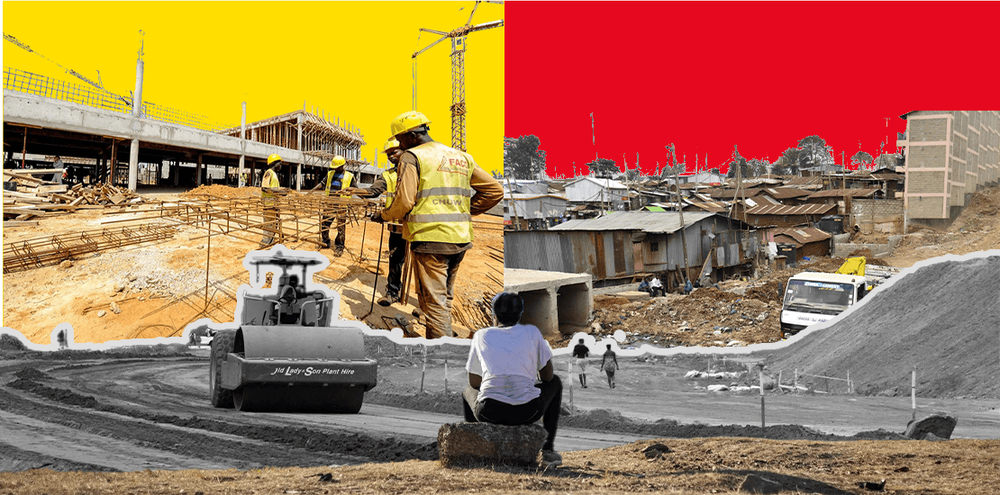
Public-private partnerships (PPPs) have established themselves as the "miracle" tool used by African states to make up for lost time on highways, ports and railroads. But the promise of efficiency masks a blind spot: the contractual opacity that allows front companies and political clans to extract rents guaranteed by public money. When revenues are secured by tolls, tax exemptions and exchange rate guarantees, the private sector captures the flow, while the risk reverts to the State. This asymmetry is not inevitable; it is the result of poorly controlled arrangements and opaque negotiations, often conducted outside parliamentary scrutiny and without publication of the contracts.
The structure is well known. A PPP is based on a project company (SPV) that raises debt and capital, then entrusts execution to subcontractors. Nothing illegal about that. The problem arises when the SPV piles up "affiliated" subsidiaries, foreign-registered holding companies and lateral contracts (assistance, management fees) that siphon off cash. Endorsements and change orders re-characterize costs, while traffic and exchange rate guarantees freeze annuities for decades. Without disclosure of actual beneficiaries and financial models, public authorities lose their ability to audit, and citizens their right to understand.
A case in point: port concessions in West Africa. In France, criminal proceedings are underway against the Bolloré Group for bribery of a foreign public official in Togo, in connection with the award and extension of concessions in Lomé and Conakry. In 2021, the Paris judicial court refused to approve a plea of guilty (CRPC) proposed by Vincent Bolloré; in 2023, the Court of Cassation validated the continuation of the investigation; in 2025, NGOs demanded the restitution of profits for the benefit of local populations. The court documents describe a typical sequence of events: political communication services at advantageous prices, obtaining endorsements, then contractual lock-in through long durations and exemptions. No final judgment has been handed down, but the case sheds light on the porous interface between political influence and the capture of port concessions.
On the rail side, the example of Rift Valley Railways (RVR) (Kenya-Uganda concession) reveals another loophole: conflict of interest masked by shell companies. In 2018, the World Bank announced that Africa Railways Logistics Limited had been sidelined for two years, after establishing that an executive, also the owner of a subcontracting company, had attempted to "unduly influence" customs formalities linked to the import of locomotives. Journalistic investigations also documented vehicles registered in Mauritius being used as expense receptacles. The concession, already weighed down by missed targets, was eventually terminated: an illustration of a PPP that has become a financial ploy to the detriment of the promised service.
On the road, the Lusaka-Ndola route in Zambia sums up the current tensions. In March 2023, a ministerial presentation to Parliament confirmed a 25-year PPP, worth around $650 million for 327 kilometers, with detour and upgrading of related sections. Existing tolls are to be transferred in stages to the concessionaire; public pension funds (notably NAPSA and the Workers Compensation Fund) have been mobilized as debt. On paper, engineering soothes out expenditure and promises long-term maintenance. In practice, it concentrates two classic risks: the privatization of a fiscal flow without full transparency of contracts, and the socialization of political risk (traffic, expropriations, foreign exchange) if forecasts prove too optimistic.
Other lessons can be drawn from international disputes. In Djibouti, several arbitration awards and foreign court decisions handed down between 2018 and 2025 ruled that the expropriation of a terminal entrusted to a foreign operator was illegal. The authorities invoked sovereignty and suspicions of irregularities; the courts opposed contractual clauses and the stability of commitments. A provisional moral: the law sanctions arbitrariness but does not correct upstream opacity. If the award was made in the grey areas of the procedure, the litigation will condemn the State... without restoring the general interest.
It's not all doom and gloom. Where governance is solid, PPP remains relevant. South Africa, for example, has formalized a demanding manual that tests affordability, risk allocation and "value for money" before any launch, and provides for close monitoring during execution. Multilateral donors publish lists of sanctions and practice cross-liability forfeiture. But these safeguards become ineffective when direct agreement replaces competitive bidding, contracts are not published, and registers of beneficial owners remain empty.
So what can be done? Firstly, impose public, verified and up-to-date registers of end owners for all SPVs and their subcontractors, including when the holding companies are offshore, with criminal penalties for concealment. Next, publish all contracts, amendments and financial models (traffic, exchange rates, inflation); prohibit operator executives from holding shares in subcontracting entities, either directly or via relatives; house tolls in co-signed and audited escrow accounts; and make independent ex-post "value for money" audits mandatory when refinancing.
The real test of African PPPs is not the speed of construction, but the ability to neutralize the toxic alliance between opaque legal vehicles and national clientelism. Without transparency, large-scale projects will continue to be fuelled by big schemes, and the bill will remain public.

 Algeria

 Democratic Republic of Congo
 FR
FR
 EN
EN