
 Senegal
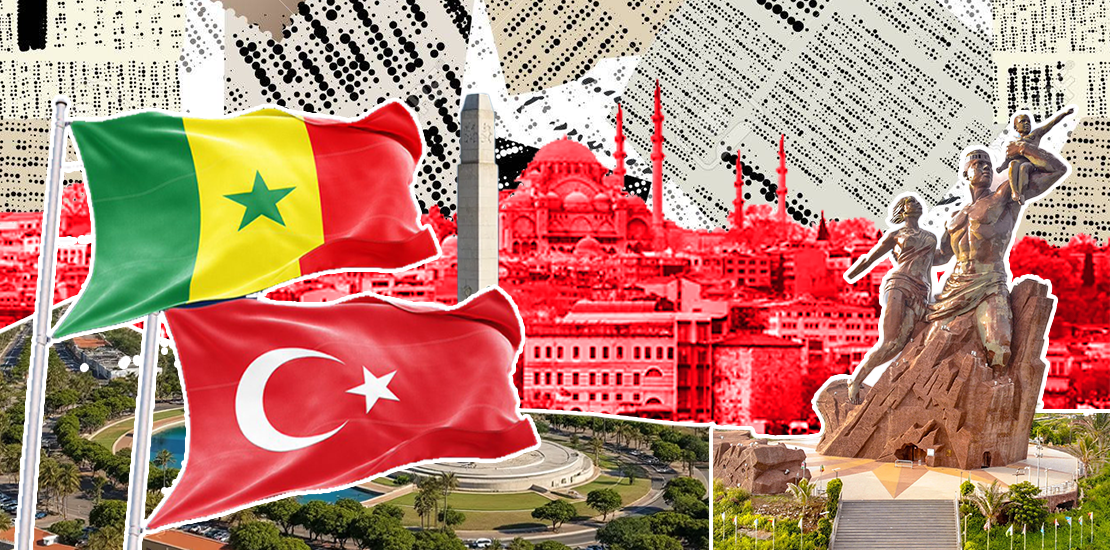
In Diamniadio, the new showcase city of "emerging Senegal," several major facilities (Abdoulaye Wade Stadium, Dakar Arena, Abdou Diouf International Conference Center) bear the mark of Turkish groups. Built by Summa and financed in part by Turk Eximbank, these infrastructures symbolize a bilateral relationship that extends beyond construction to include energy, defense, and economic diplomacy.
Since the early 2010s, Turkish companies have established themselves as key players in major construction projects in Senegal. In addition to the sports and conference facilities in Diamniadio, the Summa-Limak consortium completed the final phases of the Blaise- Diagne International Airport, a strategic infrastructure project designed to make Dakar a regional air hub. These projects are in line with the agenda of the Emerging Senegal Plan, which focuses on infrastructure to attract investment and position the country as a gateway to West Africa.
Turkey's presence is also expanding in the energy sector. Off the coast of the capital, a Karpowership floating power plant, coupled with an LNG storage and regasification unit, supplies a significant portion of the country's electricity. The facility is part of the transition to gas strategy, as the first volumes of Senegalese hydrocarbons begin to be exploited. The stated objective is to secure supply while lowering the cost per kilowatt hour.
In the social sector, cooperation is more discreet but still has a structuring effect. For example, the Turkish agency TİKA has supported the modernization of the National Orthopedic Equipment Center in Dakar, renovated the prosthetics and orthotics laboratory, and financed specialized training for Senegalese medical teams. At the same time, Turkish private actors are involved in more controversial value chains, such as the processing of fish into meal for aquaculture, which has been criticized for the social and environmental impact of this industry on fishing areas such as Joal-Fadiouth.
In terms of security, Ankara has become an important partner for Dakar. In 2022, Turkey and Senegal signed a military cooperation agreement formalizing a rapprochement that was already underway on the ground. Specialized sources indicate that Senegalese forces operate Bayraktar TB2 drones supplied by the Turkish defense industry, used for surveillance and certain operations in the unstable Casamance region, often with technical support from Turkish teams.
This cooperation is not limited to drones. In recent years, the Senegalese gendarmerie has introduced Turkish Otokar Cobra II and Ejder Yalçın armored vehicles, illustrating a rapid diversification of its suppliers. Recent agreements concluded in Ankara also provide for "military financial cooperation," training programs, and joint search and rescue activities. Signed in 2025 in the presence of President Recep Tayyip Erdoğan and Prime Minister Ousmane Sonko, these texts reinforce the anchoring of Senegalese forces in the Turkish defense ecosystem.
This move comes as France's military presence in West Africa is being readjusted. In 2025, France ended its permanent presence in Senegal by handing over its last bases, while affirming its desire to maintain training cooperation. For some observers, the challenge for Dakar will be to ensure that the diversification of partnerships does not simply result in the substitution of one arms supplier for another, without any real gain in strategic autonomy.
On the commercial front, the relationship is presented by both capitals as complementary. Senegal exports raw materials (lead, seafood, animal meal, phosphate derivatives) to Turkey, while it mainly imports manufactured goods, construction materials, electrical equipment, and consumer products. Bilateral trade, which is still modest on a global scale, is nevertheless growing steadily: recent data show Senegalese exports to Turkey amounting to tens of millions of dollars per year, with the balance of trade remaining favorable to Ankara.
The Turkish authorities highlight the presence of their construction and energy companies as a showcase for their expertise in Africa. For their part, Senegalese officials emphasize the ability of these players to deliver heavy equipment in a matter of months, where other partners impose longer procedures. The Turkish authorities cite some 30 projects already completed in Senegal worth several hundred million dollars, making the country one of the main areas of activity for Turkish companies in West Africa.
This convergence of interests is part of a broader strategy: Turkey is seeking to consolidate an African clientele for its construction, energy, and defense companies, while Dakar is attempting to diversify its support beyond the traditional circle of Western donors, in a context of debt tensions and strong social demands.
Turkey's foothold in Senegal can only be understood at the continental level. Since the mid-2000s, Ankara has significantly increased its exports to Africa, from a handful of billion dollars in the early 2000s to more than $30 billion today, according to various estimates, and has multiplied its diplomatic representations to around 44 embassies on the continent. This presence combines several levers: active presidential diplomacy, a network of embassies, Turkish Airlines flights, infrastructure projects, TİKA programs, educational foundations, and arms sales.
Senegal occupies a unique place in this system. A stable, French-speaking country with a strategic coastline and now a gas producer, it offers Turkey a foothold in a West African region undergoing restructuring. High-level reciprocal visits, from Macky Sall to Istanbul, then Recep Tayyip Erdoğan to Dakar, and more recently Prime Minister Ousmane Sonko's trip to Ankara, reflect the desire to make the partnership long-lasting and give it a strategic dimension.
For Senegal, the challenge is to use this relationship to strengthen its economic and security sovereignty without finding itself locked into a new bilateral dependency. The sustainability of the debt linked to major projects, the transparency of arms contracts, and the place given to other African, European, Asian, or Gulf partners will be decisive factors. The real nature of Turkish influence between Dakar and Ankara in the medium term will depend on this ability to ly arbitrate between multiple interests.
 Algeria
 Democratic Republic of Congo
 FR
FR
 EN
EN