
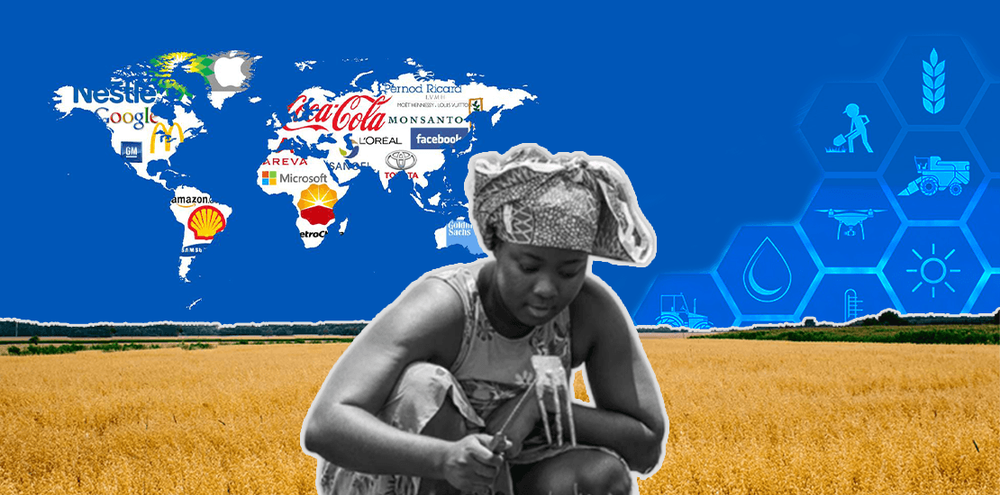
From the Sahel to the forests of Gabon, a new map of agricultural power is emerging. It is measured not just in hectares, but in contracts, standards and infrastructures that enable agribusiness giants (Olam, Cargill, Syngenta and a few others) to steer public policies as well as markets. The continent, still dependent on food imports, sees its sovereignty being negotiated behind the scenes: stability clauses, exemptions and public-private partnerships condition access to land, seeds, credit and outlets. The point is not to demonize foreign investment, but to understand how the combination of land, processing and inputs establishes an economic hierarchy that largely eludes governments and producers.
First lever: land, the heart of sovereignty. Major land acquisitions are most often tied up in multi-decennial leases, with stabilization clauses and legal guarantees that neutralize future tax revisions. Land registers remain incomplete and impact assessments rarely public. In Gabon, the joint venture between the state and Olam for palm oil illustrates this strategy: large-scale concessions, integrated plantations and mills, out-grower schemes via the GRAINE program. The authorities tout jobs and certification, while NGOs document land clearance and conflicts of use. Without contractual transparency, it is difficult to verify the reality of the compensation promised to communities and the ecosystem.
The second lever is processing and trade, where the discreet power of the trading houses is expressed. In Côte d'Ivoire and Ghana, Cargill has invested massively in cocoa-grinding capacity, making certain units the largest in Africa and consolidating a pivotal position between millions of small-scale growers and major global brands. When Abidjan and Accra introduced the Living Income Differential (LID) of $400 per ton in 2019 to raise revenues, traders compensated by adjusting other price components. The result is ambivalent: the principle of better remuneration has been established, but the market power of intermediaries and extreme price volatility have limited its effect. National authorities, constrained by their own budgetary balances, have not always been able to pass on the recent surge in prices to growers.
Third lever: seeds and agrochemicals, the matrix of future dependencies. Four groups (including Syngenta) now control a large share of the world's commercial seed and pesticide markets. In Africa, "modernization" is based on harmonized rules (ECOWAS, COMESA, SADC) and plant variety protection laws inspired by the 1991 UPOV Act. Supporters hail quality standards and a more fluid regional market. Critics point out that these frameworks tighten the stranglehold on farmers' seeds: taxation of informal exchanges, registration costs, restrictions on the right to resow. The risk is twofold: genetic homogenization in the face of climatic shocks, and value capture through royalties and "technology packages" that are often inaccessible to family farms.
To these three pillars must be added a fourth, political one: the ability to steer reforms. Major corporations sit on sector platforms, co-finance social programs, publish "zero deforestation" roadmaps and forge public-private partnerships with under-resourced administrations. Nothing illegal, but a structural imbalance: when agreements remain confidential, parliaments and communities lose the upper hand. In such a context, the law is made up of circulars, protocols and voluntary charters, where the voice of producers carries less weight than that of the holders of capital and information.
The consequences are concrete. Where industrial holdings are reconfiguring space, access to water, pasture and transhumance corridors is tightening; promises of jobs are running up against mechanization and seasonality; wages, indexed to international prices, are becoming volatile. In cocoa, cooperatives are struggling to negotiate on equal terms; the cost of inputs and compliance services is squeezing margins; indebtedness is on the rise. Above all, food security remains fragile: fertile land is being exported, while staple food imports are on the rise. The "trickle-down effect" argument - the idea that export-led industrialization would mechanically secure the plate - is not borne out without robust accompanying policies.
Does this mean we should close the door to multinationals? No: infrastructures, standards, capital and technologies can all be useful. But public arbitration must regain the upper hand. The first requirement is transparency and accountability. Publish contracts, exemptions and performance indicators; require registers of beneficial owners; impose enforceable mechanisms of free, prior and informed consent, with effective means of redress. Second requirement: competition and taxation. Prevent dominant positions on logistics corridors; make benefits conditional on local content, purchases from cooperatives and skills transfer; combat aggressive optimization by enforcing transfer pricing rules.
Last but not least, we need to generate value as close to home as possible. Industrialize, yes, but with interprofessional bodies governed on an equal basis; stabilization funds that are genuinely counter-cyclical; crop insurance and patient credit policies; massive investment in open varietal research and agro-ecology. Traceability and non-deforestation requirements, which are now unavoidable, must not externalize costs to growers: a share of the extra price paid downstream must be allocated, through transparent public-private contracts, to the renovation of orchards, the restoration of landscapes and soil health. This is the price that must be paid for strong institutions and clear rules, if Africa is to be able to attract the capital it needs without surrendering its food sovereignty.

 Algeria
 Democratic Republic of Congo
 FR
FR
 EN
EN